|
RICHARD
DAWKINS: CRITICISMS AND REBUTTALS
Richard Dawkins is beyond any doubt the new high priest of the militant
atheist movement. With his work, The God Delusion, he has officially
declared war on religion and has made clear his aim to fight it until its
demise is accomplished. But brilliant believing minds are not
declaring defeat that easily, as the following rebuttals indicate.
"After
reading a great deal of this bombast, I have come to the conclusion that
Richard has never assumed the duties of a Professor of the Public
Understanding of Science - a position he holds due to the patronage of a
zillionaire from Microsoft. He seems to lack the intellectual confidence to
say anything of substance, so he sticks to the very safe path of appealing
to materialist prejudices."
Philip Johnson,
"Richard
Dawkins."
Philip Johnson's Weekly Wedge Update.
<http://www.arn.org/docs/pjweekly/pj_weekly_010709.htm>
(31 July, 2008).
(Philip
Johnson is a former Law professor at Harvard University, who authored the
book, Darwin on Trial.)
"To give an example: The God Delusion trumpets the
fact that its author was recently voted one of the world's three leading
intellectuals. This survey took place among the readers of Prospect
magazine in November 2005. So what did this same Prospect magazine
make of the book? Its reviewer was shocked at this "incurious, dogmatic,
rambling, and self-contradictory" book. The title of the review? "Dawkins
the dogmatist."
But what of the arguments themselves? The God Delusion
is often little more than an aggregation of convenient factoids, suitably
overstated to achieve maximum impact, and loosely arranged to suggest that
they constitute an argument. This makes dealing with its "arguments" a
little problematical, in that the work frequently substitutes aggressive,
bullying rhetoric for serious evidence-based argument. Dawkins often treats
evidence as something to shoehorn into his preconceived theoretical
framework. Religion is persistently and consistently portrayed in the worst
possible way, mimicking the worst features of religious fundamentalism's
portrayal of atheism.
In one of his more bizarre creedal statements as an
atheist, Dawkins insists that there is "not the smallest evidence" that
atheism systematically influences people to do bad things. It's an
astonishing, naïve, and somewhat sad statement. The facts are otherwise. In
their efforts to enforce their atheist ideology, the Soviet authorities
systematically destroyed and eliminated the vast majority of churches and
priests during the period 1918-41. The statistics make for dreadful reading.
This violence and repression was undertaken in pursuit of an atheist agenda
-- the elimination of religion. This doesn't fit with Dawkins' highly
sanitized, idealized picture of atheism. Dawkins is clearly an ivory tower
atheist, disconnected from the real and brutal world of the twentieth
century.
Dawkins seems to think that saying something more loudly
and confidently, while ignoring or trivializing counter-evidence, will
persuade the open-minded that religious belief is a type of delusion. For
the gullible and credulous, it is the confidence with which something is
said that persuades, rather than the evidence offered in its support.
Dawkins' astonishingly superficial and inaccurate portrayal of Christianity
will simply lead Christians to conclude that he does not know what he is
talking about -- and that his atheism may therefore rest on a series of
errors and misunderstandings. Ironically the ultimate achievement of The
God Delusion for modern atheism may be to suggest that it is actually
atheism itself may be a delusion about God. "
Alister McGrath,
"The Dawkins Delusion,"
AlterNet.
<http://www.alternet.org/mediaculture/47052>
(31 July, 2008).
"Alister McGrath
is a
biochemist and Professor of Historical Theology at Oxford University.
He may be
Richard Dawkins' most prominent critic. As the author of Dawkins' God:
Genes, Memes and the Meaning of Life, he was interviewed for
Dawkins'
recent documentary,
"The Root of All Evil." Not a frame of these interviews made it into the
final edit." (Ibid)
"Dawkins's mockery of religion is based on a
distortion of the worst kind, though. It flows from him so effortlessly, I
doubt he sees it for what it is. He is so thoroughly imbued with the
naturalist/materialist/atheist mindset that he cannot step outside of it to
take an honest look at another view."
Tom Gilson, "What's Going On In The God Delusion?" Thinking Christian.
<http://psom.blogspot.com/2006/01/root-of-all-evil-part-1-god-delusion.html>
(31 July, 2008).
"Why would someone be so much of a grinch as
to write a book as mean-spirited as this? Part of the answer may be that the
author feels threatened by creationism and religious fundamentalists. Fear,
along with a sense of victimhood (which is a unifying factor in many special
interest groups), is one of the few emotions that can produce such smallness
of spirit."
T. J. Nelson, "The God Delusion,"
(Book review). <http://brneurosci.org/reviews/god-delusion.html>
(31 July, 2008).
"This is the only context
that can explain Dawkins's programme, a piece of intellectually lazy polemic
which is not worthy of a great scientist. He uses his authority as a
scientist to claim certainty where he himself knows, all too well, that
there is none; for example, our sense of morality cannot simply be explained
as a product of our genetic struggle for evolutionary advantage."
Madeleine
Bunting, "No Wonder Atheists are Angry: They Seem Ready
to Believe anything."
The Guardian.
<http://www.guardian.co.uk/media/2006/jan/07/raceandreligion.comment>
(31 July, 2008).
"It’s all in good fun when Dawkins
mocks a buffoon like
Pat Robertson and fundamentalist pastors
like the one who created “Hell Houses” to frighten sin-prone children at
Halloween. But it is less edifying when he questions the sincerity of
serious thinkers who disagree with him, like the late
Stephen Jay Gould, or insinuates that
recipients of the million-dollar-plus Templeton Prize, awarded for work
reconciling science and spirituality, are intellectually dishonest (and
presumably venal to boot). In a particularly low blow, he accuses Richard
Swinburne, a philosopher of religion and science at Oxford, of attempting to
“justify the Holocaust,” when Swinburne was struggling to square such
monumental evils with the existence of a loving God."
Jim Holt,. "Beyond Belief."
New York Times,
Sunday Book Review.
<http://www.nytimes.com/2006/10/22/books/review/Holt.t.html?ex=1319169600&en=d9a0ba69b41f32df&ei=5088&partner=rssnyt&emc=rss>
(31 July, 2008).
"The God Delusion is liberally sprinkled
with imaginary opponents (‘Here is the message that an imaginary
“intelligent design theorist” might broadcast…’, ‘the following statement
from an imaginary apologist…’, ‘My imaginary religious apologist…’, ‘Let’s
invent an imaginary quotation from a moral philosopher…’), as if Dawkins
can’t be bothered to engaging with the real opposition. The best that can be
said about Dawkins’ The God Delusion, then, is that it is a mixed
bag. Jim Holt’s assessment is, in my opinion, actually rather understated:
"The
book fairly crackles with brio. Yet reading it can feel like watching a
Michael Moore movie. There are lots of good, hard-hitting stuff about the
imbecilities of religious fanatics and frauds of all stripes, but the tone
is smug and the logic occasionally sloppy."
Peter S. Williams,
"Who's Afraid of the Big Bad Wolf? Richard Dawkins' Failed Rebuttal of
Natural Theology."
Access Research Network.
<http://www.arn.org/docs/williams/pw_goddelusionreview2.htm>
(31 July, 2008).
| |
We Believe in God
The Greatest
Artists, Musicians, Philosophers, Scientists, Writers and Poets Believed
in God...(And
a great many Nobel-Prize winners).
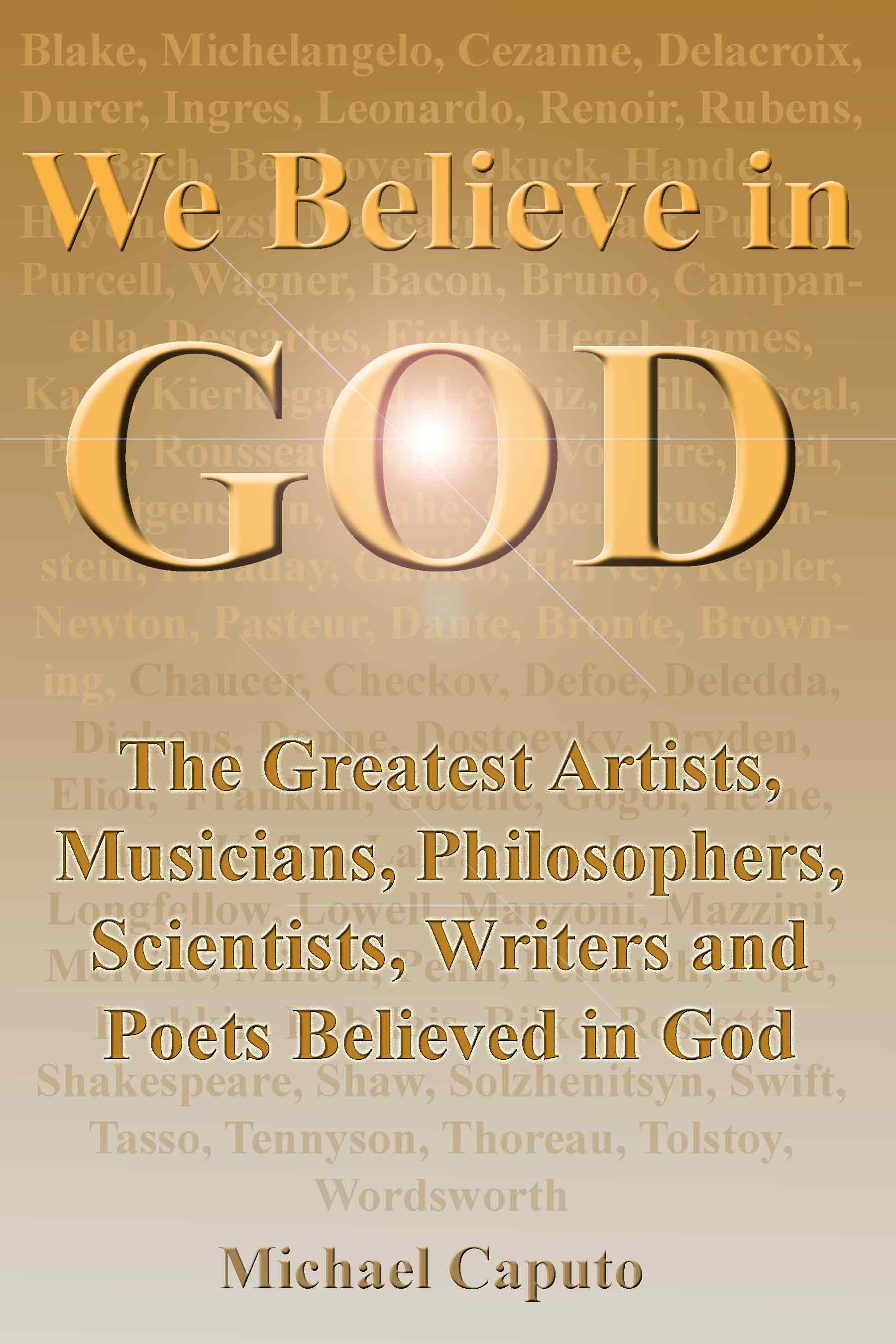
Unlike what atheists propagate, the greatest minds of
the past believed in God.
Read the fully-referenced proofs in this book.
AVAILABLE IN BOTH PAPERBACK AND E-BOOK
FORMAT ON AMAZON. |
|
|
Free Booklet from UCG.org
Life's Ultimate Question: Does God Exist?
(No
Follow Up)

|
OTHER DAWKINS PAGES
ON THIS SITE
Dawkins Lack of Brilliance Exposed -- From His Own
Words: One
paragraph from the Preface to The God Delusion tells all.
The
God Delusion,
Preface Analysis:
A close look at the aims, fanaticism and irrationality of Richard
Dawkins.
Dawkins and Einstein,
on the Bible and Jesus Christ: Unlike Dawkins, Einstein saw
great value in Biblical morality.
Is Richard Dawkins Satan Possessed?
Is Dawkins possessed by the Devil?
Dawkins and Nobel Prize Winners:
To
Dawkins almost all Nobel Prize winners are unbelievers.
What are the facts?
Chapter
by Chapter Analysis of, The God Delusion:
An in-depth analysis of this intellectually frail work by a major
apologist.
Extraterrestrials? Yes! God?
No way! Dawkins
reaches the peak of absurdity, in Ben Stein's "Expelled...."
A Crucial
Message to Richard Dawkins:
A brief appeal to a man who might still mend his ways.
God
and a "Gigantic Intelligence":
Dawkins is open to the possibility of a "Gigantic Intelligence" --
but
not God.
RELATED WEB SITES
conservapedia.com/Richard_Dawkins
Dave Crofts, "The
Root of all Evil? Part 1'
Part 2"
John Lennox, "God
and Richard Dawkins" Bethinking.org.
Nick Pollard, "The
Root of all Evil? The problem with Richard Dawkins' faith."
Peter S. Williams, "Is
Life Designed or Designoid? Dawkins, Science and the Purpose of Life."
Peter S. Williams, '"What
do you believe is true even though you cannot prove it?" - Comparing
Dawkins' Blind Faith with Flew's Evidence."
Alister McGrath,
"Dawkins' God: Genes,
Memes, and the Meaning of Life."
(Blackwell, 2005)
"Climbing
Mount Improbable, A review of Climbing Mount Improbable by Richard Dawkins"
"A
Critique of Richard Dawkin's Views on Religion"
"The
Dawkins Confusion"
"The
Devil's Chaplain"
"Lennox-Dawkins
Audio Debate"
"No
wonder atheists are angry: they seem ready to believe anything"
"Reflections
on Dawkins' The Blind Watchmaker
"
"Some
thoughts on Richard Dawkins' The God Delusion
"
"Unweaving
the Rainbow: Science, Delusion, and the Appetite for Wonder"
HIGHLY RECOMMENDED!
The Dawkins'
Delusion
(Alister E. Mc Grath)
God is No Delusion
(Thomas Crean)
HOME
|